Late 20's Male With a Beard Fashion
Meet Josh. Josh is a xxx-year-old creative person/chef who lives in a converted warehouse in Hackney, east London. Josh has a beard, glasses and cares well-nigh the provenance of his coffee. He pays his tax, doesn't have a 9-to-v job and, forth with his five polymathic flatmates, shuns public transport, preferring to ride a cycle.
On paper, Josh is the archetypal hipster – just don't call him one: "I don't detest the word hipster, and I don't hate hipsters, simply being a hipster doesn't mean anything whatever more. Then God foreclose anyone calls me i."
At some bespeak in the final few years, the hipster changed. Or at least its definition did. What was once an umbrella term for a counter-culture tribe of immature creative types in (by and large) New York'south Williamsburg and London'due south Hackney morphed into a pejorative term for people who looked, lived and acted a certain style. The Urban Dictionary defines hipsters as "a subculture of men and women, typically in their 20s and 30s, that value independent thinking, counter-culture, progressive politics". In reality, the word is now tantamount to an insult.
How to exist a hipster
And so what happened? Chris Sanderson, futurologist and co-founder of trend forecasting agency The Hereafter Laboratory, thinks it's unproblematic: "The hipster died the minute we chosen him a hipster. The discussion no longer had the same meaning."
Fuelling this was a report terminal month from researchers at the University of New Southward Wales who discovered that the hipster look was no longer "hip". In short: the more commonplace a trend – in one example, beards – the less attractive they are perceived to exist. And in 2014 we may have reached "pinnacle beard". Could it be that the flat-white-drinking, flat-cap-wearing hipster will soon cease to exist?
Sanderson thinks it'southward more a case of evolving than dying. Talking to the Observer last week, he suggested there are now 2 types of hipster: "Contemporary hipsters – the ones with the beards we love to hate – and proto-hipsters, the existent deal." And herein lies the defoliation.
"Historically, proto-hipsters have been connoisseurs – people who deviate from the norm. Similar hippies. Over the years, though, they inspired a new generation of immature urban types who turned the notion of a hipster into a grossly commercial parody. These new hipsters want to appear a certain style, to exist seen to exist doing certain things, but without doing the research. So they appropriated the lifestyle and mindset of a proto-hipster."
It's a definition neatly summarised in the song Sunday, by Los Angeles rapper Earl Sweatshirt: "You lot're only not passionate well-nigh one-half the shit that you're into."
The problem is that it is now almost impossible to differentiate betwixt the two. "Hipsters are more interested in following; proto-hipsters are more interested in leading. All the same they look the aforementioned, so how are people to know the deviation?"
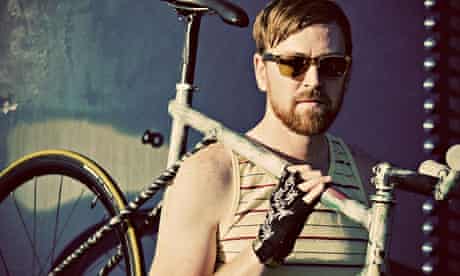
This lack of visual disparity has probably led to society's fondness for hipster-bashing. Every bit Alex Miller, UK editor-in-chief of Vice, explains: "I couldn't define a hipster. I guess information technology's 'The Other'. But equally a general term it's blown upward because people finally realised they had a word to mock something absurd and young which they didn't understand."
It's an age-old scenario. In Distinction, his 1979 report on the social logic of taste, French academic Pierre Bourdieu wrote that "social identity lies in departure, and deviation is asserted against what is closest, which represents the greatest threat". So our inability to define a hipster merely fuels the enigma.
"And equally yous tin can imagine, this is greatly exasperating to proto-hipsters," says Sanderson.
It hasn't ever been similar this. While the definition of hipster hasn't altered vastly over the years, at that place was a time when it was considered to exist something both meaningful and specific.
The discussion was coined in the 1940s to define someone who rejected societal norms – such as eye-grade white people who listened to jazz. So came a reactive literary subculture, realised through the work of beatniks such as Jack Kerouac and William Burroughs. It was Norman Mailer who attempted to ascertain hipsters in his essay The White Negro as postwar American white generation of rebels, disillusioned by war, who chose to "divorce oneself from club, to exist without roots, to set up out on that uncharted journeying into the rebellious imperatives of the self".
A decade later, we had the counter-civilisation movement – hippies who carried their torch in a adequately self-explanatory way, divorced from the mainstream. The word generally vanished until the 1990s, when it was redefined so as to describe heart-grade youths with an interest in "the alternative".
In the "noughties", hipsters became the stuff of parody, via Chris Morris and Charlie Brooker'due south satire Nathan Barley, which earmarked the "twats of Shoreditch". Nowadays, though, anyone tin appear to be a hipster provided they purchase the right jeans. From the twee Match.com adverts featuring hipster-style couples to the cocktails served in jam jars at the trendy incomer bar the Albert in EastEnders, "the thought of the hipster has been swallowed upward by the mainstream", says Sanderson.
Luke O'Neil, a Boston-based culture author for the online magazine Slate, says it is the same in the United states. "I've even noticed what I phone call the meta-hipster: a person who sidesteps the traditional requirements and just wants to skip ahead to the status. Like putting on spectacles and getting a tattoo somehow makes you lot a hipster," he says.
Only while Miller agrees that hipster has morphed into a negative term, it is less nigh the word and more about what it represents: "Growing up, we merely used other words – 'scenester' at university, 'trendies' at school – and they mean the same. Hipster has simply become a word which means the opposite of authentic."
Not anybody agrees. At Hoxton Bar and Grill in eastward London, 24-yr-old graduate Milly identifies with hipsters: "I mean, that'south why we all live in due east London. It merely feels so real, like something creative and absurd is happening."
Manny, a 28-twelvemonth-old singer who has lived in Dalston for more than than five years, likes the sense of community: "Immature people haven't got jobs or work and they need information technology. It's like a tribe, like goths. I promise hipsters aren't expressionless, because I just signed a year lease on my flat."
Miller adds: "We've never written about hipsters as a subculture at Vice because I don't retrieve hipsters are a subculture. However, I do appreciate that people like the idea of belonging to something, so I suppose on that level the idea exists." As O'Neil explains: "Whoever said [hipsters] wanted to exist unique? I think it's more about wanting to belong."
So what next? "I think hipsters will take an overhaul. There will be a downturn in this skinny-jean, long-haired feminised look over the side by side few years owing to the rise of the stronger female role model," says Chris Sanderson." And in its place? "A more macho wait, almost to the bespeak of extravaganza, in a bid for men to reinforce their identity."

Peradventure this explains the phenomenon of "normcore", a term coined by New York tendency agency K-Hole in their Youth Style report terminal fall. Though widely derided past the fashion world, this patently, super-normal style is arguably a reaction to the commodification of individuality, the thought that you tin buy uniqueness off the peg in Topshop. "Normcore doesn't desire the freedom to go someone," they say. "Normcore moves away from a coolness that relies on difference to a post-authenticity that opts into sameness."
It sounds like a joke but, says Sanderson, it might actually might be a thing: "Information technology's the reverse of what people call up is hip at present, merely it'due south also very masculine – which ties in to the render to blokeiness."
Simply for many, including Josh, the desire to categorise people is infuriating. Arvida Byström is a Swedish-built-in, London-based artist, photographer and model. Though sometimes identified every bit a hipster aesthetically speaking, her work, which focuses on sexuality, self-identity and contemporary feminism, would suggest she is much more than that. Sanderson would draw her equally "someone who leads non follows".
She balks at the idea of being a hipster: "I haven't been aware of people calling me a hipster. I certainly don't identify as one. What is a hipster, anyway? It is such a full general term. I don't even know if they be any more than."
Just every bit Josh says: "I don't see why you tin't merely be a guy in east London liking the stuff that's around without beingness branded as something."
0 Response to "Late 20's Male With a Beard Fashion"
Post a Comment