Old Fashioned Field Hockey Tunic Uniforms
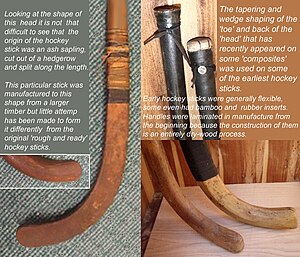
Early hockey sticks of English language manufacture.
In field hockey, each role player carries a stick and cannot take function in the game without it. The stick for an adult is usually in the range 89–95 cm (35–38 in) long. A maximum length of 105 cm (41.three") was stipulated from 2015.[1] The maximum permitted weight is 737 grams.[ii] The bulk of players apply a stick in the range 19 oz to 22 oz (538 g - 623 one thousand). Traditionally hockey sticks were fabricated of hickory, ash or mulberry wood with the head of the sticks being paw carved and therefore required skilled craftsmen to produce. Sticks made of wood continue to be made but the higher grade sticks are now manufactured from blended materials which were first permitted after 1992. These sticks ordinarily contain a combination of fibreglass, aramid fiber and carbon fibre in varying proportions according to the characteristics (flexibility; stiffness; resistance to affect and abrasion) required.
Early rules [edit]

After centuries of dissimilar variations of field hockey (including a version in England, old prior to 1860, in which, because of the very hilly heathland area in which it was played, a rubber cube and not a ball was used), the game became more organised and regularised.
By 1886, when an association of clubs was formed and the game became more than standardised, the mod game every bit we know it began (and a white painted cricket brawl had become the standard object to play with). The game had too by this fourth dimension divided into diverse branches which developed every bit divide sports. Shinty, a game popular in Scotland, uses both sides of a round stick with a curved end, which is shaped in a similar manner to a walking stick; the Irish game, hurling, uses both sides of a stick which is apartment on both sides and shaped somewhat like bill-hook with an axe-like handle. Bandy too uses both sides of the stick. It was called "hockey on water ice" in the showtime, as it was considered an ice variety of hockey. The stick in England, possibly because of the shut clan with it of cricket players, developed with a stick with but one flat playing side, the left face, beneath a round grip area—with the apply of the right-face side, which is rounded, prohibited—an oddity that had a profound consequence on the later evolution of the hockey stick and of the game itself.
There take been only three parts of a hockey stick ever named in the rules: the caput, the handle, and the splice. Originally (until 2004) the handle was the role above the bottom stop of the splice and the head was the part beneath the bottom terminate of the splice. Other terms in mutual use are "grip", which refers to the function of the stick held, specially that expanse held with two hands when striking the ball. Almost sticks have a circular grip which is covered in a non-sideslip, sweat absorbent, fabric record. The handle remains rounded on the reverse, back or right paw-side but becomes gradually flat on the "face" side and also becomes wider, changing from a diameter of approximately 30 mm to a flat width of approximately 46 mm (the permitted maximum was two in—at present 51 mm). This flat area higher up the curve of the caput is generally referred to as the "shaft". The head of the stick is generally thought of as the curved role. The right side is called the face, the upturn the "toe" and the bend of the caput where it joins the shaft the "heel". In recent times using the edges of the stick (as well as the confront side) to strike at the ball has been permitted and thus "forehand border stroke" and "reverse border stroke" will be institute in rule terminology. Forehand and reverse stroke refers to the taking of these strokes, from the right or left hand side of the body respectively, equally the stick may exist used "face up" or "face down" to brand an border stroke, the ii edges of the stick are not separately named just simply referred to as edges.
Initially in that location were 6 rule requirements applying to the hockey stick:
- The stick had to be flat on the playing side (the left side when the toe of the stick head is facing away from the user).
- It had to be able to exist passed completely through a two-inch (internal diameter) ring.
- The stick was to exist polish (no rough or abrupt edges).
- The head of the stick was to be a) curved and b) made from woods.
- A maximum and minimum weight were specified, 28 oz and 12 oz respectively.
During the 19th century, field hockey evolved in England. This evolution led to the cosmos of the Federation Internationale de Hockey (FIH) in 1924.
Contance Applebee is responsible for introducing field hockey to the United States in 1901. The United States Field Hockey Association was formed in 1922.
In 1908, men's field hockey was introduced into the Olympic Games. Women's field hockey was starting time recognized in the Olympic Games in 1980.
The World Cup is the crowning achievement in international field hockey. The World Cup is held every iv years and 12 men's and 12 women's teams compete for the championship of World Champion.
Head length [edit]

Reversed head in various positions confronting a stick held forehand.

Hockey stick caput overlays

The extreme in brusk heads
The offset major developments to what was later on termed the "English language style" stick (and the method of play with such sticks) occurred in India. (The game in its mod course was apparently brought to India by the British Army, although there does non appear to exist any specific evidence of this. But certainly hockey was played by the British forces in India.) At that time the stick head was very long (in backlog of 12"—300 mm) and made from an indigenous British timber, ash. The Indians then produced sticks with a much shorter head length and a tighter heel bend and used mulberry, which is tougher than ash, merely has like bending characteristics and weight and is easy to work. This development changed the nature of the game, led to the "Indian dribble" and to Indian authorization of the game in the outset half of the twentieth century.
A hockey stick is occasionally used in the vertical position shown, but manipulating the move and the direction of the ball in a controlled mode (dribbling) is carried out in what is termed a "dribbling crouch", when the handle of the stick will usually be angled betwixt 35° and 55°. Hit or pushing the ball can exist done with the stick at any angle between the vertical and horizontal and recent changes to the rules allow even the edges of the stick to exist used to sweep or strike at the ball on the ground. The various stick caput designs can be compared in respect of how, with the handle at an angle of 45°, they differ in the carrying out of the Indian dribble, i.due east. decision-making the direction of the ball by rotating the stick caput over the tiptop/front of the ball rather than (or also as) effectually the back of the ball (the English manner dribble). The multi-layered stick caput diagram indicates the changes in head shape and length that occurred over xxx years or and so.
The primeval trend was in shortening the stick head. While that reduced the stopping expanse of the head it was beneficial because, according to the rules at the time, only one side of the stick head could be used (at that time the ball could not be played with the edges of the head or handle but with the flat side or face side only).
Using extreme examples is useful every bit a means of demonstrating effects that occur in less extreme configurations but are much more difficult to spot and therefore to explain. The starting time ascertainment is an easy one (top left in the image captioned "Reversed head in diverse…"). If the stick head is rotated onto the reverse (lighter colour) the toe is not going to disappear into the ground to enable the reverse side of the stick to be presented to the ball—a vertical adjustment is necessary. Secondly (top right), if the handle of the stick is kept at exactly the aforementioned angle and rotated, a horizontal adjustment is necessary to bring the reversed head to a position where contact will be made with the ball. The tertiary effigy (bottom left) shows these adjustments having been made (and a change to the bending of the handle because the position of the hand holding the stick at the top would be virtually the same as information technology is when gripping the stick in the forehand position), but the area of stick head making contact with the ball is very small; so control may not be adequate. The fourth figure (lesser right) demonstrates that to get skillful contact with the ball on a larger area of the reversed head, it is necessary to motion the handle much nearer to the vertical. This ways the player must bring the brawl in very shut to the feet and come to a more upright dribbling position—this in turn impairs the power to scan the pitch and keep the ball in peripheral vision at the same time—a considerable disadvantage when dribbling to evade opponents.
And then, although the long caput stick was an acceptable shape for a dribbling style which was based on moving the brawl forrard from directly backside the ball; and changes of direction could be achieved past rotating the stick around the back of the ball and/or moving the feet to either side of the ball, it was non so easy to utilize the long stick head to bring the ball across the feet and back again, particularly when it was placed wide to the left of the feet of the player. (This left side position was compounded in difficulty with a very severe interpretation of "obstruction", which prohibited shielding of the brawl from an opponent. The game was too, at the time, seen every bit "right-sided" and positioning the body between the brawl and a close or closing opponent, approaching from the right hand side, was non allowed.) Reversed stick hitting, pushing and flicking would exist short range skills and difficult to practice accurately, if at all, specially when moving at speed.
Gradually over many years stick heads were made shorter and the "heel" was made to a tighter curve. This procedure continued until the "ane piece" head could non exist fabricated to a sharper bend without the timber splitting out on the base. As it was, attempts to have the grain follow entirely the aforementioned curve every bit the curve, as it should for maximum forcefulness (this is why the timber is aptitude rather than cutting to shape) were abandoned past some producers and an upturn to the toe was sometimes achieved by cutting beyond the wood-grain at the toe cease of the caput to achieve the desired shape. Some manufacturers resorted to gluing a separate slice of wood on top of the toe or glued additional strips of timber to the inner edge of the handle higher up the head to get the outcome of a tighter heel bend. ("Head adjustment" frequently happened to update sometime style stock or where unmodified presses were in employ.).
Some players were cut function of the toe off their sticks, to achieve a shorter head, and rounding the cease off, (although on the older styles this did nothing to tighten the curve to the heel and oft just ruined the stick). Predictably, there were sticks produced for the 1986 World Cup with heads with a horizontal length of only 95 mm. The international players to whom they were handed out tried them and so returned them as unusable.
The difficulty was twofold: i) The toe was so short that it could not be rotated completely over the superlative circumference of the ball and 2) When the stick head was played effectually the back of the ball information technology "ran off", because there was insufficient "run length" to the stick head. If, for instance, a player "propped" the ball while moving in a dribbling crouch (putting the stick head over the front of the brawl), drew the ball dorsum towards his feet and then took the stick head around the back of the ball to bring it forwards again, possibly moving the brawl off in another management (a common motility), the margin for mistake was so small that the ball could hands slip off the stick head. The ultra-short stick head was to some extent based on the thought that the new bogus surfaces would lead to a style of hockey based on stopping the ball with the handle of the stick near horizontal to the ground and that dribbling to elude opponents would be almost eliminated with near continuous passing of the brawl. Although there was a development of "system hockey" that overcame the stick/brawl skill deficiencies of the Europeans compared with Republic of india and Pakistan at the fourth dimension, information technology was not every bit fluid equally the kind of ane and two touch passing game common in soccer and that ideal was (and yet is) a long way off.
The claw [edit]
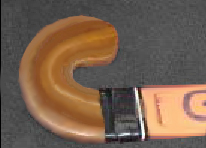
"Hook" manufactured past Grays circa 1986
In 1982 a Dutch inventor, Toon Coolen, patented a hockey stick with a "hook" head. The hockey stick manufacturers Grays took the design up in 1983 and the first mass-produced hockey sticks, with laminated timber caput parts, were manufactured in Pakistan. This new design was possible because of the development of epoxy resin glues that did not require perfectly dry out timber for bonding and curing to a strength that could cope with the immense stresses placed on a stick caput when a hockey brawl is struck with it.
By 1993 the "Hook" patent, had been ruled (following a court case in Frg) to protect only hook shapes within 20° of the vaguely written "near 180°" (referring to the degree of upturn of the toe in relation to the shaft of the stick in the patent description; the shaft of the handle existence described a being aptitude through "most 180°" to form the claw shape of the stick head). That opened the way for the advent of more than J-shaped stick heads and the gradual morphing of the "midi" shape with the hook shape. In that twelvemonth also a patent application, lodged in Pakistan in 1987 by Martin Conlon, for a kinked shaft hockey stick, with a set-back head (which was also claw shaped, but non to "well-nigh 180°"), was granted after potent opposition in Islamic republic of pakistan. (Indian and Britain patents had been granted in 1988, although the same company had besides opposed the UK patent application). Mr. Conlon designed and imported to the UK the kickoff J-head sticks in 1990 but, prior to the 1993 conclusion, other distributors and manufacturers had been very reluctant to social club made or produce claw manner sticks of any sort, because of uncertainty about the forcefulness of the patent that "band-fenced" the hook hockey stick.
The "midi" caput [edit]

Comparison of "One-piece" and "midi" style stick heads

Comparison of horizontal head length of "hook" and a standard short caput stick
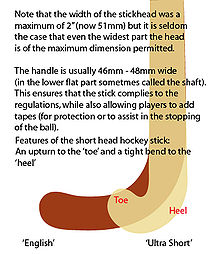
"English" stick head and the "Ultra Short"
The decease knell of the ultra short head was sounded in 1986, due to the introduction of the midi head shape, produced with a laminating process; although of grade many players continued to use "one-piece" short head sticks for many years after that appointment and many thousands more of them were manufactured. The reason for the continued employ of the one piece was that the midi length was similar to that of the more popular one piece stick heads that had been effectually for the previous ten or so years. Some i piece constructions were still being produced on presses on which the central boss had not been modified and the heel curve was "slower" than on that of the production of the more enlightened manufacturers, simply the more "go ahead" manufacturers were producing a one piece that could compete well with the laminated midi—at least equally far as playing functionality was concerned.
The biggest casualty of the midi was the patented Hook produced past the same company. Information technology had non taken off in the Britain civilisation of the short-caput stick and for a number of years after the midi was introduced the Hook was seen as something of a novelty, even as an indoor stick or a stick exclusively for goalkeepers. In fact versions of information technology were produced specifically for goalkeepers, with a very extended toe (6 in—150 mm or more) and that development continued until some were made with the toe extending nearly the length of the handle and the FIH stepped in and ruled that the vertical toe limit was in future to be 4 in (100 mm).
The hook was 124 mm, measured horizontally across face of the stick caput, when the handle was held vertically; the midi was 113 mm; many ane piece heads between 110 mm and 115 mm, and the unusable ultra short 94 mm. A departure of only 30 mm between the head length of a stick that was considered cumbersome (although the Hook also had the height of the toe causing a feeling of imbalance) to one that was considered too brusque to easily play with. At that place were still many players playing quite happily with a stick with a head length of seven in (175 mm), simply players buying new sticks were now witting of quite subtle differences in stick feel and operation due to length, shape, and the distribution of head weight—non just the total ounce weight and the "swing weight or residuum" of the stick—and for the showtime time, in the years afterwards 1986, were being offered a wide range of hockey sticks from a greatly increased number of manufacturers, from which to choose what suited them. Subsequently the arrival of the laminations, some brands were offer every bit many as 10 different shapes or styles of stick head on the traditional shaft. The inflow of composites would complicate the picture further.
In the early 1990s there were an astonishing number and diverseness of hockey sticks on offer compared with what had been available x years earlier. Past 1992, hockey stick reinforcement was a big issue and composites had been accepted into an (extended) FIH experimental trial catamenia (there was a peachy deal of concern near the power generated by these new reinforcements and the safety of players). In that location were also hockey sticks with metal handles and inserted plywood heads (made by the American company Eastons, better known for making baseball bats), besides equally the wide range of one piece head sticks still produced and an expanding range of laminated midi and laminated shorties. The metallic handled sticks were later banned for "safety reasons", in what was widely regarded as a political move by the FIH.
Heel curve, ball position, hitting & stopping [edit]
Information technology may be noted from the diagram higher up that no matter how "tight" the heel bend, reversing the stick head over the ball, with a "traditional" style hockey stick head, e'er requires both a vertical and horizontal adjustment of the stick caput position. This is non anywhere near every bit difficult as it was with the very long head stick and this sort of adjustment volition be nigh sub-witting in an experienced histrion. Note besides, that when the shaft is held vertically, the ball is more deeply stopped, when on the ground, to the toe side of the shaft rather than in the eye of the shaft. Novice players oftentimes assume that the center of the brawl will align with the centre of the shaft when stopping the ball in this way and every bit a result, the ball deflects off to the heel side and normally into their feet. Because of the heel slope on the stick head the vertical shaft stop is actually much easier to bear out securely (when the ball is on the basis) if the handle is held at least 10° off the vertical, with the acme of the handle sloped to the player'due south left. When the brawl in the air, a little off the ground, below knee height for case, is ofttimes easier to catch the ball correctly if the handle is vertical.
1 of the incidental effects of the tighter heel bend of the modern stick is an increase in playing reach with the optimum striking or stopping role of the head of the stick when used in the normal range of playing angles. Held parallel the distance between the curve of the base of the stick caput and the acme of the handle is the same in the two sticks illustrated. At an angle of 45°, equally shown, there is a difference of approximately iii cm.

Tighter curve giving greater striking and stopping reach

Ball positioned mid-face up of long head and ball positioned against face of mod hook
The positioning of the ball mid-confront on the stick caput of the modern stick, compared with the mid-face position on the longer stick, also brings the centre of the ball much closer to a line projected through the centre of the handle and the circumference closer to the back edge of the stick, enabling ameliorate close control of the brawl.

"English language" manner stick held vertically
It will be appreciated after a glance at the illustration of the 'English' mode hockey stick that stopping a ball on the basis with the handle held vertically would non be easy. If the ball is lined upward centrally with the centre of the handle (reddish) it would be likely to deflect off the heel side of the head. Even with the brawl positioned central to the head (blue) stopping would not have been very secure with an upright handle.

Stopping and striking with the 'English' head
Presenting the stick at an angle of 35° or more (40° in the illustration) solves the problem of the ball running off the head by presenting a very long expanse behind the ball (relative to the width of the brawl) but presents the problem of the best or optimum position to stop the ball for the following activeness. For striking the optimum positions seems to be where a line projected through the leading edge of the shaft of the handle passes through the centre of the ball because it is the position closest to the centre line of the handle where the entire width of the head is behind the ball. Stopping the brawl closer to the toe of the stick is adequate but not optimal, equally aligning, which takes time, is necessary before the next intended action.

In the modernistic stick the vertical handle position is still not equally secure every bit an angled presentation of the handle only the angle now can exist considerably less, because of the tighter heel bend and the stopping and striking positions of the ball are easier to decide. The line of the leading edge of the handle all the same projects close to the center of the brawl when the angle of the stick handle is in the 30°–50° range and a line through the centre of the handle will projection to the back and underside of the brawl.
Set-back heads, ball position & stopping [edit]

Vertical stopping position Set-back on Claw

Ball positions on stick heads between "slow heel" and "prepare-dorsum".
The analogy called 'Stopping and Hitting' shows that when a vertical stick shaft is aligned to the centre of the ball role of the ball protrudes to the heel side, this would happen even if the heel was non a bend simply a 90° corner and the only manner to cover the entire ball with the shaft held vertical is to employ a set-back head—that is a head that is set up-back to the heel side of the shaft.
A stick with a prepare-back head and toe-side protrusion, with the handle positioned vertically, covers substantially more of the ball and can reduce off heel deflection errors in stopping. Using the prepare-dorsum head in the more comfortable or natural stopping angle puts a vertical area of shaft above the ball while at the same time aligning centre ball and a line projected through the middle of the handle.
In the upright hitting position, which is generally between xv° and 25° off vertical, the heel bend of the Indian stick of the 1970s will cover the whole brawl. As the heel bend gets tighter in the 1980s and 1990s the ball is controlled closer to the eye line of the stick but it is not until the setback stick appears that the centre of the shaft is aligned (or nearly and so) with the middle of the brawl. The ball appears to move dorsum along the length of the various stick heads as the heads become shorter and the heel tighter, in fact the playing position of the brawl is moved farther and further from the anxiety as playing attain is increased.

Setback head without shaft protrusion on conventional head.

Setback comparison of "recurve" and "kinked shaft" sticks
At that place are presently two styles of outfield set-back stick, the degree of setback to the caput is a feature they have in common; they differ in that ane has a 'kink' or shaft protrusion on the toe side above the caput of the stick while the other does not. In the goalkeeper versions some too accept the toe of the caput cut flat (parallel to the handle) rather than rounded to allow the user to present the stick closer to the ground when stopping in a horizontal position on the reverse side, this is to more easily prevent the ball from going under the handle of the stick.
The mod hook [edit]
In the mid-90s the "hook" head style hockey stick was relaunched, this time past the old German U21 International player Thomas Kille. Bright colours, bold graphics and painted heads were introduced. Manufacturers became much more aware of the await of their products and hockey sticks sold, especially to new players, equally much on color and fashion as force and usability.

Comparison of original claw shapes with modern designs.
Today, across many brands, there is a choice of angle of claw upturn, 45°, threescore°, and 75°. A style of stick that virtually no-1 in Europe wanted to apply in 1987, is today used virtually universally; it is difficult now to find a role player who is not using a hook style hockey stick and many of them have never used the "shortie" way at all; just as many of the players of today accept never played hockey on a natural grass pitch—the development of artificial surfaces has as well had a significant event on the ways in which hockey sticks are used.
The original version, the 'Hook' relied on a patent description that put the inner side edge of the toe parallel (or nearly and then) to the facing border of the handle. The vertical height of the toe was approximately fourscore mm (dotted line) Fig.1 and it was of almost uniform thickness with the residual of the stick caput.
Early modification Fig. 1. reduced the horizontal caput length to approximate 115 mm and the 'toe meridian' to approximately 75 mm. A hockey ball is between near 71 mm and 75 mm in diameter (224–235 mm in circumference)—so that put the 'toe height' at the same height every bit the maximum height of the ball. This is a common feature across claw head designs today, the toe generally varies in meridian, betwixt the minimum and maximum height of the ball, when the handle is in a vertical position.
The next development was a claw with a toe with an inner edge that sloped away from the handle by approximately 30° (a 60° angle to the footing or a 150° 'upturn'. The 'toe height' was 75 mm. (Modernistic versions Fig. 2 vary betwixt 70 mm and 75 mm. in toe height.) The horizontal length of the head was based on the length of the 'standard' jumpsuit short-head stick, approximately 110 mm. and modern versions seem to vary between 110 mm and 115 mm. The mid-90s saw the introduction of the more 'open' hooks Fig. iii, some at 45° and a significant increase in horizontal head length, some as much as 120 mm.
New names have been coined to depict the diverse hook shapes but there is much confusion and overlapping of names. 'Maxi' and 'Mega' are also terms for styles of hook shape but there is no mutual understanding about what these terms mean outside of each 'brand' name that employs them: what one make terms a midi another calls a 'hook' but, basically, there are three types of hook. The near symmetrical 'U', a 'tight' or 'closed' toe shape, between threescore° and 75° and an 'open' shape of 45°–55°. Where the toe is shorter the same toe angles are generally referred to as midi.
Set-dorsum stick heads [edit]

The curve to the 'heel' side of the handle
The big headed 'Hook' also suffered for a short time from the appearance at the 1986 World Cup of the first sticks with gear up-back heads. There was not a significant impact only it (and others) added to the full general confusion, as apparently 'everyone and his canis familiaris' were presenting new ideas in head shape. (Metal handled and fully composite sticks had non yet made an advent so at the time the 'battle' was nigh head shape and length rather than materials and to a bottom extent, considering hockey players at the fourth dimension tended to exist more than 'traditionalist', the head/handle configuration. Even reinforcement with fiberglass and carbon fibre was not the effect information technology was afterwards to go.
I hockey stick produced by AREC for the French inventor, Jean Capét, had the heart of the handle aligned with the heart of the horizontal length of the head. In that location was a lot of promotion based on 'rotational residue' and the 'sweet spot' and 'power hitting'. The 'Hook' certainly felt out of rotational balance, especially to those who had been playing with short-head sticks that had been fabricated with a very thin toe, so equally to concentrate the weight of the head closer to the shaft.
Aligning the heart of the handle with the centre of the horizontal length of a curt-head, rather than with the centre of the ball created some unusual playing characteristics, for case, the reversed-stick brawl position being further from the anxiety than the forehand brawl position, which is the contrary of what happens with a conventional 'traditional' handle head configuration. (When the centre line of the handle aligns with the centre of the brawl—or very nearly and then—there is no or very little difference in ball position in relation to the stick or the feet of the player between the forehand and opposite playing positions.)
The AREC stick was initially produced without a significantly upturned toe and had a brusque horizontal length (approximately 105 mm), it was in this regard similar to standard short-caput sticks of the time. The lack of an upturned toe, combined with the unusual reverse brawl position, caused some difficulty in adapting to the stick and when the horizontal caput lengths of sticks began to exist made longer, by popular demand. A stick with the handle aligned to the centre of the head length was no longer applied for playing hockey. Industry of it equally an outfield stick ceased in the early 1990s, probably by 1992 but like sticks, by other manufacturers, accept appeared for goalkeeper apply.
Kinked-shaft & recurve heads [edit]
The traditional small arc to the heel border of the hockey stick had the effect of setting the stick head back slightly. This aspect of stick blueprint (of which the AREC hockey stick was an extreme instance) was first explored just prior to the Men'southward Hockey Earth Cup of 1986 and resulted in the production of hockey sticks with a stick head considerably more set-back in relation to the handle. The original pattern, aligning the centre line of the handle with the centre of the brawl, in the common hitting position, featured a counterbalancing "kink" or protrusion to the handle on the toe border of the handle, just in a higher place the head of the stick. This invention of the kinked-shaft and set-dorsum caput stick led straight to rules governing the amount of bend or "permitted deviation" to the "edge sides" of the hockey stick handle. Some of these were later termed "recurve" heads (a description given to a later style, produced by an Australian manufacturer, without the patented kink feature.)

The early extremes in stick design were in those sticks intended for employ past goalkeepers. The aim was just to nowadays the maximum stopping area to the ball. The first was the extended claw (far left), which was fabricated with a toe of approximately 150 mm (6 in). When sticks with an upturn substantially more than that (some more than half the length of the handle) began to announced, which was around 1988, the FIH placed a limit of 100 mm (4") on the upturn of the toe of the head.
In 1990 a plywood cutout of a stick with multiple kinks in the shaft was presented to the FIH for comment, the intention was to produce it as a goalkeeper's stick. Having express the toe upturn just two years previously the FIH saw this as mockery and issued a printing release, in April 1990, proposing a ban on all hockey sticks with "non-direct" handles to take outcome after the Barcelona Olympics of that yr. At that place was protestation from those who had been marketing sticks with set-back heads and or kinked shafts and information technology was in any case not a sensible proposal because in that location is no such thing every bit a hockey stick with a perfectly straight handle. The consequence was the withdrawal of the proposed ban and the imposition of "limits of difference", which permitted 1 curve to either side of the handle to a maximum of 20 mm on each side. In 2000 a diagram explaining the permitted deviation was included in the Rules of Hockey. Previously the only restraint on the configuration of a hockey stick was that it had to laissez passer through a ring of 2" diameter (afterwards adapted to 51 mm—2 in rounded up to the nearest millimeter).
Permitted deviation [edit]
Although permitted deviation (from the straight) to the edges of a hockey stick (handle) were included in the 1991 Rules of Hockey, a diagram of a hockey stick, to illustrate what was permitted was non included until 2000 and then it was a part stick diagram placed horizontally on a folio smaller than the A6 page of the nowadays rulebook. The diagram was very poorly drawn but information technology was a significant pace for the FIH to include it at all. The diagram remained unchanged until 2004, when the orientation was altered so that the stick was shown upright and it was also shown full length. The 10-axis (previously vertical) became the basis plane and the y-axis a vertical line through the centre of the handle. Further improvements to the diagram (particularly the drawing of the representation of the stick and an illustration of possible curves to the handle) were made in 2006 and a 2nd diagram, detailing head configuration, was added.
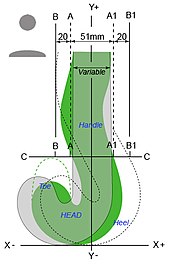
Limits of difference with sample of an bodily stick superimposed in green.

Limits of deviation, sample curves.
To describe the dimensions of head and handle the hockey stick is envisaged to be placed with the lesser bend of the stick head on a level surface, the x-axis, with the stick-handle perpendicular to it (the y-axis). The y-axis runs from an intersection with the x-axis (0) vertically through the midpoint of the superlative of the handle. The Caput is the function from the 10-centrality to the line C-C (diagram) a vertical distance of 100 mm. This line C-C as well describes the limit on any upturn to the toe of the head. By Rule there is no limit to the length of the stick caput along the x-axis, simply practical considerations, besides as technicalities related to the joining of the head and the Handle (on the line C-C), did create limitations with wooden sticks.
The extent of the stick caput along the Ten+ axis, towards the 'heel' of the Caput is confined by the rule requirement that the stick head and the handle meet in a shine continuous fashion at the line C-C and past a dominion brake on the shape of the handle, which is that the stick-handle must not projection beyond the line B1-B1. It is possible to envisage a stick where the width of handle did not extend across the line A1-A1, thus allowing a pregnant extension of the stick head along the X+ axis, simply the practicalities of such a blueprint seem to be limited and have not been explored. The length of the Head (or toe) forth the 10- axis has varied enormously, peculiarly since the Second Globe War and again subsequently the introduction of the timber lamination process in the early 1980s.
The stick handle may be bent or 'deviated', in a smooth bend but, once only to either side. That is the handle may take one out-moving curve on the 'heel' side of the head and 1 out-moving curve on the toe side. Information technology is therefore possible to have a hockey stick with a handle departure to the front or toe side or a handle divergence to the back or 'heel' side or a stick-handle that is bent once to both the toe and 'heel' sides.
The sample diagram on the right shows three deviating areas (a), (b), and (c). Any of these areas could exist on a stick by itself but, in this illustration, area (a) could legally coexist with surface area (b) and area (c) could coexist with expanse (b); merely areas (a) and (c) could not legally coexist on the aforementioned stick because they are both on the same border and simply one protrusion either beyond the line AA or beyond the line A1A1—or both—is permitted on the handle.
The maximum permitted width of the handle (51 mm) is illustrated in the diagram by the distance between the dotted lines A-A and A1-A1. A hockey stick handle volition rarely be of the maximum permitted width: well-nigh are between 46 mm and 48 mm at the widest point.
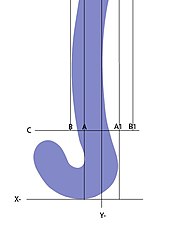
Sample goalkeeper stick with long border deviation to toe side
The maximum permitted 'deviation' is shown past the lines B-B and B1-B1 respectively. The line B-B is twenty mm farther along the X- centrality than the line A-A and the line B1-B1 is 20 mm further along the 10+ centrality than the line A1-A1. In that location is no limit to the length of a protrusion along the y-axis specified, so the difference curve or curves may be of whatever length forth the length of the stick-handle. Some goalkeeping sticks accept an outward bend on the toe side (within the line B-B) that extends for most half the total length of the stick.
The sample illustrated does not achieve the line A1A1 on the 'heel edge' and the Y axis is non primal to the shaft, which raises the question "How is the stick positioned for measurement of permitted difference." The respond is that the vertical axis Y runs through the top centre of the handle and the stick is assumed to be suspended from that tiptop centre point and perpendicular to the 10 axis (the ground), the bend to the base of operations of the head of the stick being in contact with the ground, information technology is therefore not necessary for the Y axis to pass through the heart of the shaft just in a higher place the caput of the stick, although in nearly traditional sticks information technology will do so (or very virtually do and then—as 'rake' to the handle may cause the Y axis to run a few millimeters to the heel side of the true centre of the shaft). To Oct 2015 no official measuring method or device for measuring 'permitted difference' has been approved by the FIH.
Permitted bow [edit]
Increasing the caste of bow to the face side (flat side) makes it easier to get loftier speeds from the elevate-flick (a "sling-shot" style stroke started from backside the body of the flicker) and allows easier execution of the stroke. At first, subsequently extreme bows were introduced (2005), the Hockey Rules Lath (HRB) placed a limit of fifty mm on the maximum depth of such a bow over the length of the stick, but experience quickly demonstrated this degree of bend to be excessive.
The Rules of Hockey 2006 limited this detail curve of the stick to 25 mm so equally to limit the power with which the ball can be flicked and to attempt to ensure that striking control was maintained (the curvature to the face of the stick considerably influences the bending at which the stick caput strikes through the ball). The placement of the maximum bow along the length of handle has now been specified in the Rules of Hockey at xx cm above the caput (the line C-C).

Ascertaining compliance to bow limits
Information technology is now illegal for any hockey stick to have a bow that exceeds 25 mm. The bow pinnacle is measured by placing the stick face-side to a flat surface and presenting the official measuring device, a 25 mm-high metal triangular or cylindrical measure out, to the gap between the surface and the under-apartment of the stick.
Since this article was starting time written in 2008, in that location have been attempts to get around the dominion by the production of a stick which 'in a natural resting position' has a face side that is not parallel to the flat surface measured from but rests with the face up at a sharp angle. The result of the sloping of the face side is to put i edge of it closer than 25 mm to the flat surface and permit a much deeper bow than would otherwise be possible. This flouts the intention of the rule, so it is possible that at that place may be a move to a measuring cylinder, under and across, the entire face of the stick.
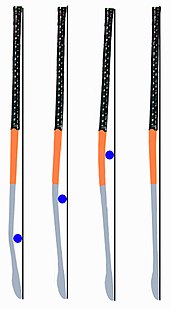
Position of bow and effect on angle of head presentation
There was a development in design chosen the 'depression bow'. This placed the maximum bow of the stick much closer to the head than was previously the case, when it was positioned more centrally on the length of the stick. The outcome of placing the maximum bow lower downwardly the handle was to increase the angle at which the stick head was presented to the ball. The angle of presentation of a '25 mm low bow' was approximately the same as was achieved when the maximum permitted bow was 50 mm only the maximum was situated at about the mid-length of the stick.
Farthermost bow has an effect on the ease with which stick-work and hitting of the ball (then that it stays on the footing) may exist carried out. There has always been some bow to a stick handle, 10–twenty mm was common (right in diagram) considering to accept a stick that was straight would make 'gathering' the brawl, by pulling it towards the body from the left, more than difficult and a bow in the other direction (a convex bow) would cause 'dragging' in stick-work and make hitting the ball cleanly difficult in the other.
A stick with a very small degree of bow (no more five mm) was popular in the days when the clip hit in the outfield was a permitted stroke (a bit hit is a hitting downward on the top or back of the ball which causes it to rising sharply and produces under-spin, and so that the ball does not run on when information technology lands). The increased use of the scoop when the lifted hit in the outfield was banned led to an increase in bow depth (and many players also plant that a moderate bow aided stick-work besides). The maximum depth of this bow was generally at around the mid-length of the stick.
The 'depression bow' has been popularized by the development of the elevate-moving picture, specially every bit a first shot on goal at a penalty corner. The Pakistan International player Sohail Abbas, who holds the tape for the number of goals scored at international level, mostly scored with the set piece drag-pic, had such a stick fabricated especially to his own requirements and many take copied his design—and tried to improve on information technology.

Hitting at various stick angles with a bowed stick.
Although there tin can be no dubiety that the 'slingshot' issue of a bowed stick, when the ball is 'dragged' from the rear of the feet and released after powerful torso and arm rotation to the front of the feet, has dramatically increased the velocity at which the ball may exist propelled by this flicking method, there may be considerable difficulty in hitting the brawl along the ground with a very bowed stick. This may be of reward when shooting at the goal with a lifted striking from within the 'circumvolve' (which is legal) just a disadvantage when hitting the ball outside of the scoring 'circles', because it is illegal to intentionally lift the ball with a hitting except when within the scoring 'circles' i.e. the opponent's 'circle'.
The upright forehand hitting stroke, which is normally used when the brawl is close to the feet, will seldom exist made with the handle in the same plane as the ball, unless the ball is to the immediate right of the player i.eastward. beside or alongside his feet. (Stick shown on far right of illustration)—which is more often than not the case when the brawl is existence hit directly to the front or from left to correct—with a bowed stick even this vertical handle position volition present an angled head to the ball. The further away to the front of the player the ball is the greater volition exist the head angle presented to the ball. To bargain with the problem of head presentation some players employ a low 'roundhouse' way of hitting, rather than an upright way and may besides employ sweep-hits or slap-hitting of the ball (the deviation being the positioning of the hands, sweep hits are more often than not made with the hands together at the summit of the stick and with the base of the stick head in contact with the ground, while slap-hits are ordinarily fabricated with the hands in the more than spread dribbling grip and the stick caput is not necessarily in contact with the ground, but information technology may be), either sweep or slap type strokes requite greater control over the angle of the face of the stick as it makes contact with the ball and are oft the preferred strokes when passing the ball over longer distances (over shorter distances—less than xx m—a push stroke is often preferred).

Stick-face contact position: Ball contact position.
The detail analogy shows that when the handle is angled away from the ball both the position of contact with the ball on the ball and the function of the face of the stick making contact will be contradistinct. The greater the bow the greater the degree of adjustment the thespian must brand to his swing and to the hit position of the ball to achieve a hit flat forth the ground.
Stages of development [edit]
The development of the mod hockey stick has non taken place in one continuous flow with each development following on from a previous one. Many things changed in the same time frame just at unlike speeds, peculiarly some of the later developments. There take been more than changes in stick design in the last twenty-5 years than there were in the previous one hundred and 20-five and the pace of change has been an always increasing one. In that location volition no dubiousness be further development, probably in materials, possibly because of changes to the rules. In roughly chronological social club this is what has happened and then far.
- 1860s: Hockey taken to India. Stick head made shorter; motility from ash to mulberry timber for the stick caput.
- Further shortening of stick head; heel of head made tighter. Taken as far every bit possible by 1986, when a motility back towards a midi length began.
- 1960s: Reinforcement with fiberglass.
- 1970s: Reinforcement with carbon and aramid as well as drinking glass fibres.
- 1980s: Stick heads made from glued lamination of wood in addition to the 1 piece heads
- 1982: Introduction of upturned toe, first the hook closely followed by midi and "J" shaped designs.
- 1980s: Limit placed on upturn of toe of caput at 100 mm.
- 1986: Kinked shaft stick. Set back stick head.
- 1980s: Stick lengths other than 36", up to 39", become widely available and custom lengths 42"+ can be purchased.
- 1990: Permitted deviation rule—limited bends to edges of stick handle defined.
- 1990: Specialist goalkeeper's sticks introduced, the offset beingness the ZigZag Relieve.
- 1980s: Metal handled stick with an inserted wooden head (plywood) introduced.
- 1994: Composite sticks fully accepted in rules later a two-yr "experiment".
- 1990s: Metallic handles banned.
- 2004: Dominion redefining of head and handle. Head the part from the base of the curve perpendicular to 100 mm—handle the residuum of the stick.
- 2000s: Refinement of head shapes, probably 5 shapes bachelor every bit "standard".
- 2000s: Number of forest cadre sticks in utilize declines as moulded "composites" become the norm.
- 2006: Bow of the face of the handle is increased to facilitate elevate-flicking. Closely followed by a rule concerning maximum permitted bow; initially at l mm and after at 25 mm.
- 2007: Low bow sticks introduced.
- 2011: Maximum stick bow position non permitted to be less than 8" (20 cm) above the head of the stick.
- 2013: Maximum permitted weight reduced to 737 g (26 oz)
- 2015: Maximum length limit of 41" (105 cm)introduced.
The forehand hitting position [edit]

Brawl position for propelling
For the purposes of this article the ball will be assumed to be 73 mm in bore. Ball size does play a significant office in stickwork and ball control (every bit does the weight and hardness of the ball) just an investigation of these is outside the scope of this article. The width of stick handles does vary (equally does the horizontal length of stick heads) simply for clarity and convenience the shaft of the handle just above the head has been taken as 46 mm, which is adequately mutual, and the sticks scaled from that measurement.
The position of the ball when it is played, particularly hitting with the stick head, does, however take a begetting on stick head design. Using just one of the whole range of angles the ball may be struck at from the forehand (right-mitt) side (45°), the position of the ball will be looked at in relation to both the centre of the caput of the stick and a line projected to run through the center of the handle. An test on the position of article of clothing on the base of stick heads that have been used over a period on an abrasive playing surface lead to the decision that the brawl is positioned close to the center of the head length of the modern stick. This is also the more than usual position for receiving or stopping the ball in play while in the 'dribbling crouch'. Evidently when the handle is vertical or horizontal there is considerable variation but in most common hit and dribbling positions the line of the uppermost edge of the handle projects shut to the middle of the ball.
Ane of the problems with a striking head that is significantly narrower than the diameter of the ball is that the ball is easily lifted unintentionally if struck with the face of the stick head inclined backward, 'open', rather than vertical or nearly so. Striking the ball with a 'airtight' face up is not always a solution, because it is then possible to 'squeeze' or 'clip' information technology, again causing the ball to rise, possibly even more steeply than with the so-called 'undercut' hit.
Some other difficulty is striking the ball accurately at the point on the stick caput that is intended (the usual range of error tin can be seen, in the diagram, in the difference of the lengths of the red lines that run from the centre of the 2 differently positioned stick heads).
It is also necessary to avert unintentionally turning the handle during a hit at the ball so that the ball is "sliced" (to the right) or hooked (to the left), this is achieved by gripping the stick firmly, by and large with one hand locked against the other at the top of the handle, at the moment of impact with the brawl.
Ensuring vertical and flat (perpendicular to intended direction of brawl travel) contact with the ball is in the hands of the role player and the coach, but achieving a right contact position between the stick head and the brawl can be helped by the blueprint of the stick.

"Heel" position, toe peak
At a mutual playing angle three unlike styles of hook stick caput present identical ball/handle relationships because the curve of the 'heel' is the aforementioned in each stick. An increase in the pinnacle of the toe over the ball is very noticeable and is most pronounced in the more than 'open' shape. The modern hook does not suffer from the effects of a rotational imbalance in the head as much as the original did because stick heads are at present generally tapered towards the toe, rather than of uniform thickness and so toe superlative is non, from a weight and rotational residual point of view, every bit much of an issue as it once might have been. The stick head is also generally tapered from the midpoint of the hitting expanse towards the lesser curve, so when the stick is in the reversed position the maximum thickness of the head is not at the highest signal. This gives a more balanced rotation of the weight of the stick head over the ball.
Some of the early hooks were actually thinner in the eye and became thicker in the toe; it is probable that this was washed to facilitate more powerful reversed-stick hitting of the ball but information technology gave the stick unusual treatment characteristics when turning information technology over the ball and back in "stickwork": an "overturning" or "throw" of the stick caput had to exist taken into account. The blended stick is more often than not lighter than the previous woods versions and it is unusual these days to find a young histrion using the 25–26 oz sticks that were quite unremarkably used on grass in the 1970s, especially past those probable to be regularly taking hits at a stationary ball.
Field hockey stick brands [edit]
The majority of modern hockey sticks are manufactured in Asia (Islamic republic of pakistan, India, and China predominantly). Manufacturers will often produce sticks for a number of different brands.
- PROENIX (PRO-NIX)
- Adidas
- AMI
- Atlas
- Aratac
- Arissa
- Aigle
- Brabo
- Brine
- Byte
- Goad Hockey
- Whirlwind
- Dita
- Dragon
- Dunlop Slazenger
- Edge
- Espada
- Falanx
- Flash
- Grays
- Gryphon
- Harrow
- Indian Maharadja
- ISHAN
- JDH
- Just Hockey
- KUNS Hockey
- Kookaburra
- Kappa Esse
- Lycan
- Lekker Hockey
- Mantis
- Mazon
- Megatz
- Mercian
- Model
- MOHINDER
- Monarch
- Nedstar
- No Fear
- OBO
- Osaka
- Otter Hockey
- Piranha
- Princess
- Prodigy
- Rage
- Rattler
- Ritual
- Slazenger
- Simbra
- STX
- Simian
- Stag
- Talon
- TGI
- TK
- Tribaal
- Uber
- Vampire
- Voodoo
- Wasp
- WH
- Woodworm
- Y1 Hockey
- ZigZag
- Zoppo
Encounter besides [edit]
- Ice hockey stick
References [edit]
- ^ International Hockey Federation (1 January 2019). "Rules of Hockey including explanations". England Hockey . Retrieved 1 December 2020.
- ^ Rules of Hockey 2015-2016
0 Response to "Old Fashioned Field Hockey Tunic Uniforms"
Post a Comment