French Women From 1890s Womens Fashion 1890s
Women fashion in the 1890s is characterized past long elegant lines, tall collars, and the rise of sportswear. Information technology was an era of great dress reforms led past the invention of the driblet-frame safety cycle, which allowed women the opportunity to ride bicycles more comfortably, and therefore, created the need for appropriate clothing.
Victorian dress reform
Victorian dress reform comprising various reformers who proposed, designed, and wore clothing considered more applied and comfy than the fashions of the time. The move emerged in the Progressive Era along with calls for temperance, women's education, suffrage and moral purity. Dress reform called for emancipation from the "dictates of mode", expressed a desire to "embrace the limbs every bit well as the trunk adequately," and promoted "rational apparel". The movement had its greatest success in the reform of women's undergarments, which could be modified without exposing the wearer to social ridicule. Dress reformers were also influential in persuading women to adopt simplified garments for able-bodied activities such as bicycling or swimming. Some proponents of the movement established dress reform parlors, or storefronts, where women could buy sewing patterns for the newfangled garments, or buy them directly.
Belle époque
Europe has years of excess (1890-1914); this becomes la belle époque(the beautiful era). It is the time of the beau monde. They are carefree years and there is a sunny optimism, wealth and decadence. Rich people earn a neat deal in a short period of time through the industrial revolution and retire to the countryside for sumptuous feasts and exclusive dinners. A social club lady is expected to dress upwards several times a twenty-four hours, from sober richness or a walking dress to an impressive evening attire. In this time many mode houses in Paris are founded. The British court is bursting with luxury thanks to the Indian colony.
In 1890, the woman's waist was tightened with a short corset and an hourglass model was created. The brim is bong-shaped and the balloon-shaped sleeves are used high. In 1895 a loose skirt with loftier-cut blouse or jacket with head sleeves appears. From 1900 women article of clothing a long 'health corset', which provided an S-line. The ribs are no longer crushed, only the skeleton is distorted. Some women clothing health-care vesture: shapeless 'bag-style' dresses without a corset.
Women'south fashions
Stylish women'south clothing styles shed some of the extravagances of previous decades, just corseting connected unmitigated, or fifty-fifty slightly increased in severity. Early on 1890s dresses consisted of a tight bodice with the skirt gathered at the waist and falling more than naturally over the hips and undergarments than in previous years.
The mid-1890s introduced leg o'mutton sleeves, which grew in size each year until they disappeared in about 1906. During the same period of the mid-1890s, skirts took on an A-line silhouette that was almost bell-like. The late 1890s returned to the tighter sleeves often with small puffs or ruffles capping the shoulder merely fitted to the wrist. Skirts took on a trumpet shape, plumbing fixtures more closely over the hip and flaring only higher up the knee. Corsets in the 1890s helped ascertain the hourglass figure as immortalized by artist Charles Dana Gibson. In the very late 1890s, the corset elongated, giving the women a slight S-bend silhouette that would be popular well into the Edwardian era.
The hat is the capeline adorned with feathers or ribbons.
The coat is worn very long, crossed with a double row of buttons on a jacket- fitted jacket with puffed sleeves at the top and tightened by long gloves at the bottom.
The satin often busy with velvet and sequins are on the way.
The bodice is gathered on the bust or with a plastron and the sleeves are puffy.
The braceletand velvet necklace or assorted ribbons are the essential accessories; necklaces of this kind are called choker.
In front of the boom of the bicycle, other elements of the suit appear: the curt pants and gathered at the knees, it is worn with leggings or stockings and a bodice with a scoop cervix and puffed sleeves. It is possible to add together a short skirt on the pants or even a skirt. The whole with a jacket-jacket floating broad-lapel worn with or without a fluffy tie which already foreshadows the tailor.
 1890 | 1891 | 1895 |  1895 | 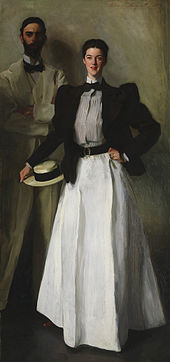 1897 |
|---|


Wearing apparel
By 1890, the crinoline and bustle was fully abased, and skirts flared abroad naturally from the wearer's tiny waist. It evolved into a bell shape, and were made to fit tighter around the hip area. Necklines were loftier, while sleeves of bodices initially peaked at the shoulders, but increased in size during 1894. Although the large sleeves required cushions to secure them in place, it narrowed down towards the end of the decade. Women thus adopted the style of the tailored jacket, which improved their posture and confidence, while reflecting the standards of early female liberation.
Sportswear and tailored fashions
Changing attitudes about adequate activities for women also made sportswear pop for women, with such notable examples every bit the bicycling dress and the tennis dress.
Unfussy, tailored dress, adapted from the before theme of men's tailoring and simplicity of class, were worn for outdoor activities and traveling. The shirtwaist, a costume with a bodice or waist tailored like a man'due south shirt with a high collar, was adopted for informal daywear and became the uniform of working women. Walking suits featured talocrural joint-length skirts with matching jackets. The notion of "rational apparel" for women'south health was a widely discussed topic in 1891, which led to the development of sports clothes. This included ample skirts with a belted blouse for hockey. In addition, cycling became very popular and led to the development of "cycling costumes", which were shorter skirts or "bloomers" which were Turkish trouser style outfits. Past the 1890s, women bicyclists increasingly wore bloomers in public and in the company of men as well as other women. Bloomers seem to take been more unremarkably worn in Paris than in England or the Us and became quite popular and fashionable. In the United States, bloomers were more than intended for exercise than fashion. The ascension of American women'southward college sports in the 1890s created a need for more unencumbered move than exercise skirts would permit. Past the end of the decade, most colleges that admitted women had women'due south basketball teams, all outfitted in bloomers. Across the nation's campuses, baggy bloomers were paired with blouses to create the showtime women's gym uniforms.
The rainy daisy was a style of walking or sports brim introduced during this decade, allegedly named subsequently Daisy Miller, just too named for its practicality in wet weather, as the shorter hemlines did non soak up puddles of water. They were particularly useful for cycling, walking or sporting pursuits every bit the shorter hems were less likely to catch in the bicycle mechanisms or underfoot, and enabled freer movement.
Swimwear was also developed, usually fabricated of navy blue wool with a long tunic over full knickers.
Afternoon dresses typical of the time period had high necks, wasp waists, puffed sleeves and bell-shaped skirts. Evening gowns had a squared decolletage, a wasp-waist cut and skirts with long trains.
Influence of aesthetic wearing apparel
The 1890s in both Europe and N America saw growing credence of artistic or artful clothes equally mainstream manner influenced by the philosophies of John Ruskin and William Morris. This was especially seen in the adoption of the uncorseted tea gown for at-home wear. In the The states during this flow, Dress, the Jenness Miller Mag (1887–1898), reported that tea gowns were being worn outside the home for the first time in fashionable summer resorts.
Hairstyles and headgear
Hairstyles at the offset of the decade were merely a conduct-over from the 1880s styles that included curled or frizzled bangs over the forehead as well as hair swept to the top of the head, but later 1892, hairstyles became increasingly influenced by the Gibson Girl. By the mid-1890s, hair had become looser and wavier and bangs gradually faded from high mode. By the cease of the decade, pilus was often worn in a big mass with a bun at the superlative of the caput, a style that would be predominant during the first decade of the 20th century.
Shoes
Loftier tab front end shoes with a large buckle had made a comeback in the 1870s and were over again revived in the 1890s. This popular manner of shoe had a few names such every bit "Cromwell," "Colonial," and "Molière". At this fourth dimension materials such every bit suede, leather, lace and metal were used to fashion the shoe and decorate it. Suede was new to the market in 1890 and was bachelor in a few stake shades.
Athletic vesture
The shift toward functional fashion as well affected women'southward athletic clothing. Women in Paris began wearing bloomers when bicycling as early as 1893, while in England lower bicycle frames accommodated the dresses that women continued to wear for bicycling. Long flooring length dresses gradually gave way to shorter hemlines and a more coincidental style of athletic habiliment. Similarly, bathing suits too became shorter and less covered — still another example of the beginnings of a shift in dress toward greater freedom and functionality.
Style gallery 1890–96
| 1 – 1890-92 | ii – 1890-95 | iii – 1892 | four – 1892–93 | five – 1893 |
|---|---|---|---|---|
| 6 – 1894 | 7 – 1895 | 8 – 1896 | 9 – 1896 |


1.Praskovia Tchaokovskaia wears a high-necked afternoon dress with puffed elbow-length sleeves and a cloth belt or sash, Russia, 1890–92.
ii.Bathing conform, 1890-1895, nautical fashion : navy colour and crewman collar and sleeves
3.Afternoon dresses of 1892 have depression waists and loftier necklines. Sleeves have a high, gathered sleeve-head and are fitted to the lower arm. Skirts are fuller in back than forepart.
4.Evening gowns of 1892–3 feature curt or elbow-length full, puffed sleeves and floral trimmings.
five.Metropolis or traveling arrange has full upper sleeves and dorsum fullness in the skirt.
6.Walking suits of 1894 show shorter skirts and matching jackets with leg o' mutton sleeves.
vii.Punch Drawing of 1895 shows a fashionable bicycle adapt.
8.Natalie Barney in 1896
9.Charvet advertising in 1896
Style gallery 1897–99
| one – 1897 | 2 – 1897 | three – 1897 | 4 – 1898 | 5 – 1898 |
|---|---|---|---|---|
| half-dozen – 1898 | 7 – 1898 | 8 – 1898 | 9 – 1898-1900 | 10 – 1899 |
| eleven – 1899 | 12 – 1899 |


ane.Madame Faydou wears her hair in a knot on top of her head. Her black dress and her daughter's grey dress (probably mourning attire) have fashionable leg o' mutton sleeves, 1897.
two.Catherine Vlasto wears a white wearing apparel with puffed elbow-length sleeves and ribbon bows. Her hair is parted in the heart and poufed casually at her temples, 1897.
3.1897 fashion plate shows an idealized form of the fashionable figure. The jacket has an asymmetrical closure and new, smaller sleeve puffs.
4.Bathing costumes of 1898 accept nautical details such as sailor collars.
5.Dress of 1898 shows a short, broad puff at the shoulder over a long, tight sleeve.
vi.Charvet corsage of 1898 shows a corsage past Charvet. It is a blouse of pink cambric finely plaited, and with a white cascade frill, also of cambric, down the middle.
seven.Shirt-waist from Charvet in 1898 shows a shirt-waist from Charvet. It has a group of tucks down either side of the front and back from the shoulders, and in addition has two deep horizontal tucks across the front. A broad box-pleat at the eye is edged with a tiny black frill, which is also carried around the basque. The sleeves are tucked in diagonal groups.
8.Hats from manufacturers spring collection
9.Brawl gown (1898-1900) designed by one of the finest French couturiers during the Belle Époque, Jacques Doucet, with characteristics of the artful dress movement : "simplistic in pattern, all the same improvident by the choice of materials used. The sheer overlayer is enhanced by the solid lamé underlayers and a sense of luxury is added by the subconscious lace flounce at the hem."
ten.1899 fashion plate shows the narrow, gored skirt and more natural shoulder of the start of the 20th century (every bit well as the results of "S-bend" corseting).
xi.Tea Gown of 1899 shows "Watteau back" and frothy trim.
12.Two women in Watteau-backed tea gowns with high sashed waists, 1899.
Russian Fashion 1890s
| 1-1890 | 2-1890 | 3-1894 | 4-1896 | five-1898 |
|---|


1.Philanthropist Olga Sergeyevna Aleksandrova-Heinz, 1890
ii.Marie-Clotilde-Elisabeth Louise de Riquet, comtesse de Mercy-Argenteau, 1890
3.Neapolitan Adult female, 1894
4.Portrait of Countess Natalia Petrovna Golovina,1896
5.portrait of Tevashova, 1898
Source from Wikipedia
0 Response to "French Women From 1890s Womens Fashion 1890s"
Post a Comment